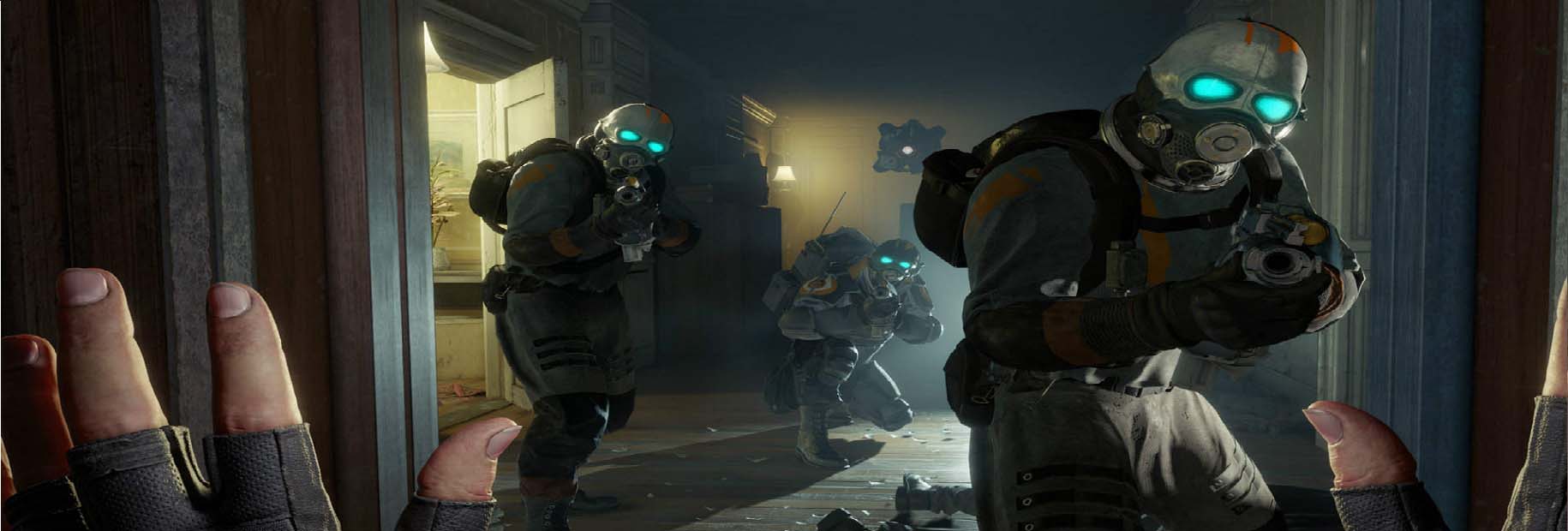
Half-Life: Alyx
Watch the videoGenre:
Number of players:
1
Feeling:
Distinguishing Factors
Half-Life: Alyx does right by intentional design for VR. From how the players move around in the world to the tiniest details in its worlds, all is carefully laid out. Among the standouts is the gravity gloves, a natural progression of the legendary Gravity Gun. The players use the gloves to pull objects towards them using wrist flicks to pull objects from the air. This comes so naturally and satisfying to do, becoming second nature when fighting as well as when exploring very early on.
The game does all that it would in a non-VR mode in VR. Players reload guns with their hands, ejecting spent mags, banging new ones home, and racking slides back. They lockpick using virtual tools inserted into keyholes and turned slowly. At health stations, players must insert a hand into an alien device, and puzzles require moving holograms and circuits around by hand. Players aren't just pressing a button; they do, so the whole thing is immersive.
Environment also needs to be kept. The rooms are filled with flotsam: debris scattered on the ground, tools lying around, cans, and scraps of paper—items that players can collect, examine, and throw away. It's these little things like scribbled notes or background chatter that fill the world with life and occupation. It's this attention to detail, not graphics, that makes Valve's inexperience at VR design sound incredulous.
Story
Half-Life: Alyx is set halfway between Half-Life and Half-Life 2. The main protagonist is Alyx Vance, a resistance soldier. She is preparing to strike a blow against the tyrannical alien regime of the Combine. Her journey is one of danger, survival, and determination as she tries to rescue her father, Eli Vance, from captivity and discover the nefarious plans of the Combine.
Along the way, Alyx is guided and assisted by Russell, a deadpan scientist sidekick. His sarcastic one-liners and motivational quotes are both humor and exposition, metering out the game between tension and humanity. The dialogue brings warmth and personality to what otherwise could be a game full of fear and uncertainty.
The narrative is a reimagining of the Half-Life series, mixing up resistance, alien occupation, and scientific wonder. Without revealing too much, the narrative concludes not only continuing the series but turning the direction of the series around. It was received across the board for taking a risk, particularly the final seconds and post-credits twist, leaving everyone scratching their heads wondering what happens next.
Gameplay
Half-Life: Alyx combat is a masterclass in the integration of VR mechanics and the traditional first-person shooter design. It's up-close, twitch shooting with strategic use of cover, scavenging for ammo, and reloading while taking fire. Not the kind of reloading where it's a button mashing in those FPS games, but here by muscle memory. The players are vaulting over trash, magazine swapping, and peeking out slowly to lay down fire. That exposure is something non-VR can't do.
In addition to combat, the other side of the game is discovery and world-building via environments. The player explores abandoned apartments, basements, and Combine facilities, piecing together what occurred there. Optional interactions and secret items are the reward for curious minds. Even something as mundane as sifting through drawers or opening a cabinet is enjoyable because of the immersion of VR.
Pacing is also accomplished with puzzles. These consist of re-wiring circuits using holographic nodes and rotating spheres filled with streams of moving energy. Puzzles never become difficult but add variety through instances of relief between combat. Aside from the horror elements of the game—i.e., combatting headcrabs in complete darkness—gameplay is varied and unpredictable.
Another area is the physicality of VR movement. Teleport movement, free movement, or both, can be chosen. Ducking in and out of things, leaning over things, or crouching behind things physically are not button mashes but body motions. It makes the players feel inserted in the world, and immersion is also improved as well as victories won.
System Requirements
As a VR-exclusive game, Half-Life: Alyx requires some reasonable headset and reasonable PC power. It is backed by several VR headsets including Valve Index, HTC Vive, Oculus Rift, and Windows Mixed Reality headsets.
The requirements are:
- Operating System: Windows 10
- Processor: Intel Core i5-7500 / AMD Ryzen 5 1600 or equivalent
- Memory: 12 GB RAM
- Graphics: NVIDIA GeForce GTX 1060 / AMD RX 580 or equivalent
- Storage: 67 GB of available space
For optimal performance, Valve recommends more powerful hardware in the way of GPUs like the RTX 2070 or higher to provide silky frame rates and graphics detail. While such requirements could be overkill, they ensure smoothness that is essential when it comes to VR comfort since lag in performance is much more disorienting in virtual reality than in standard games.
Play Half-Life: Alyx at Vrata VR Club
Half-Life: Alyx is a game-changer, messing with virtual reality and stretching the legendary Half-Life franchise. It fulfills the full range of interactive VR design, from action set-piece combat gunfights to brain-bending puzzles, from skin-crawling horror to humor.
For the rest who do not have a VR headset or gaming PC, do not despair to try this masterpiece. You can experience Half-Life: Alyx at the Vrata VR Club in Odessa, where the gaming station is designed for immersion. Put yourself in Alyx's shoes, fight the Combine, and find out why the game is among the most rated VR games of all time.
Installed on all consoles
-